
Raw Material Certifications for Sheet Metal Prototypes: What R&D Teams Need
Raw Material Certifications for Sheet Metal Prototypes: What R&D Teams Need
When prototyping sheet metal parts, the material you choose determines the part's strength, corrosion resistance, thermal performance, and cost. But how do you know the material in your prototype is actually what you specified? The answer lies in material certifications.
For R&D teams developing products that will eventually go into production, understanding material certifications is essential. This guide covers the key certification documents, ASTM and ISO standards for common sheet metals, what to check on a mill test report, and how to verify material quality when sourcing from manufacturers.
Why Material Certifications Matter for Prototypes
Material certifications serve three critical purposes in product development:
· Validation: They confirm the material meets your specified grade, chemistry, and mechanical properties.
· Traceability: They create a documented chain from the raw material supplier to your finished part.
· Compliance: Many regulated industries (medical, aerospace, automotive) require material certifications as part of design history files and regulatory submissions.
Without proper certifications, a prototype made from the wrong material grade could pass initial fit tests but fail in production when the correct material behaves differently.
Key Material Certification Documents
Mill Test Report (MTR)
Also called a Certified Mill Test Report (CMTR) or EN 10204 Type 3.1 certificate, this is the most important document for verifying raw material. An MTR includes:
· Heat number and batch identification for full traceability
· Chemical composition analysis (percentage of carbon, chromium, nickel, etc.)
· Mechanical properties (tensile strength, yield strength, elongation, hardness)
· Material specification and grade (e.g., ASTM A240 304 Stainless Steel)
· Date of manufacture and supplier information
Certificate of Compliance (CoC)
A CoC is a simpler document stating that the material meets specified requirements. It does not include test data and is less rigorous than a full MTR. CoCs are acceptable for non-critical applications but should not be relied upon for regulated industries.
Certificate of Conformance (also CoC)
Similar to a Compliance certificate, this document confirms the supplier followed the agreed specification but may not include actual test results. Always clarify with your manufacturer which type of CoC they provide.
Sheet Metal Types and Their Certification Standards
Each material type has a governing standard that defines its chemical composition and mechanical property requirements:
|
Material |
Common Grades |
Governing Standard |
Key Certifications |
|
Stainless Steel |
304, 316L, 430 |
ASTM A240 / EN 10088 |
MTR with full chemistry + mechanicals |
|
Aluminum |
5052, 6061, 7075 |
ASTM B209 / EN 485 |
MTR with temper verification (H32, T6) |
|
Cold-Rolled Steel |
SPCC, DC01 |
JIS G3141 / EN 10130 |
MTR or CoC depending on application |
|
Galvanized Steel |
SGCC, DX51D+Z |
JIS G3302 / EN 10346 |
MTR with coating weight (Z100, Z275) |
|
Copper / Brass |
C1100, C2600 |
ASTM B152 / EN 1652 |
MTR with conductivity data |
What to Check on a Mill Test Report
When you receive an MTR from your manufacturer, verify these five items:
1. Material Grade and Specification
Confirm the grade matches what you ordered. For example, if you specified ASTM A240 304 stainless steel, the MTR should list ASTM A240 and grade 304. Mismatched grades are surprisingly common and can lead to corrosion or strength issues.
2. Chemical Composition
Check that the percentages of key elements fall within the required range. For 304 stainless, carbon should be 0.08% max, chromium 18-20%, and nickel 8-10.5%. Out-of-spec chemistry can affect weldability and corrosion resistance.
3. Mechanical Properties
Tensile strength, yield strength, and elongation should meet the standard's minimum requirements. For aluminum 5052-H32, tensile strength should be 210 MPa minimum and yield strength 130 MPa minimum.
4. Heat Number
The heat number is the unique identifier for the melt batch. It should be consistent across all sheets used in your prototype. Traceability back to the heat number is how manufacturers demonstrate material integrity.
5. Date and Supplier
The test date should be recent (within 1-2 years for most materials). The supplier name should match a known mill or distributor.
Material Certification Requirements by Industry
|
Industry |
Required Certifications |
Key Standards |
Notes |
|
Medical Devices |
Full MTR (EN 10204 3.1) |
ISO 13485, ASTM F138 (implant grade) |
Full traceability required for FDA submissions |
|
Aerospace |
Full MTR + AMS specs |
AMS QQ-A-250/8 (aluminum), AMS 5504 (steel) |
AMS specifications exceed ASTM requirements |
|
Automotive |
MTR or CoC depending on criticality |
IATF 16949, customer-specific standards |
Safety-critical parts need full MTR |
|
Food Processing |
MTR with surface finish data |
FDA CFR 21, 3-A Sanitary Standards |
Surface finish and corrosion resistance critical |
|
General Industrial |
CoC or MTR |
ISO 9001, applicable ASTM/EN standards |
MTR recommended for structural parts |
ISO 9001:2015 quality management standard covers general requirements, while TWI Global provides guidance on material selection for welded fabrications.
How Chinese Manufacturers Handle Material Certifications
When sourcing sheet metal prototypes from Chinese manufacturers, material certification practices vary significantly between suppliers. Here is what to expect:
· ISO 9001 certified suppliers: They maintain documented material receiving and inspection processes and can provide MTRs from their raw material suppliers.
· Large mills: Chinese steel mills like Baosteel, Tisco (stainless), and Chalco (aluminum) issue full MTRs with every coil or sheet, matching international standards.
· Smaller suppliers: They may rely on distributor-level CoCs. Always request the original mill MTR, not a re-issued certificate.
· Key red flag: A supplier who cannot or will not provide an MTR for the material used in your prototype is not suitable for regulated or quality-sensitive applications.
Xometry and Protolabs maintain material traceability across their supplier networks. RapidDirect and XHX Metal provide MTRs on request for all prototype materials.
Prototyping Services with Material Traceability
|
Provider |
MTR Available |
Standard Cert |
Material Range |
Notes |
|
XHX Metal |
Yes on request |
CoC standard |
Aluminum, steel, stainless |
Full traceability for prototype materials |
|
Xometry |
Yes |
CoC standard |
Extensive range |
Automated system, MTR by request |
|
Protolabs |
Limited |
CoC standard |
Aluminum, steel |
Fast turnaround, less flexible on certs |
|
RapidDirect |
Yes |
CoC standard |
Aluminum, steel, stainless |
China-based, MTR available |
|
SendCutSend |
Limited |
CoC standard |
Steel, aluminum |
USA-based, fast but limited certs |
|
KDM Fabrication |
Yes on request |
CoC standard |
Aluminum, steel, stainless |
China-based, precision focus |
XHX Metal: Material Certification Practices
At XHX Metal, material verification is the first step in every prototype order. Our process includes:
· Incoming material inspection: Each sheet or coil is verified against its MTR before entering production.
· Grade confirmation: Material grade is marked and tracked throughout the fabrication process.
· MTR on request: We provide the original mill test report for any material used in your prototype.
· ISO 9001:2015 certified: Our quality management system requires documented material traceability.
· Full material range: We stock 304/316L stainless, 5052/6061 aluminum, SPCC/SGCC steel, and more.
Contact XHX Metal to request material certifications with your next prototype order.
Frequently Asked Questions
Q: What is the difference between an MTR and a CoC?
A: An MTR (Mill Test Report) includes actual test data from the mill showing chemical composition and mechanical properties. A CoC (Certificate of Compliance or Conformance) simply states the material meets requirements without providing test data.
Q: Do I need an MTR for prototypes?
A: For non-critical fit/form prototypes, a CoC is usually sufficient. For functional prototypes, especially those used in medical, aerospace, or automotive development, a full MTR is recommended.
Q: Can Chinese manufacturers provide MTRs?
A: Yes, ISO 9001 certified Chinese manufacturers can provide MTRs from their raw material suppliers. Always request the original mill MTR, not a re-issued certificate.
Q: What should I check on an aluminum MTR?
A: Confirm the grade (5052, 6061, etc.), temper (H32, T6, O), thickness tolerance, tensile and yield strength, and elongation percentage.
Q: How do I verify a material certificate is authentic?
A: Check that the heat number is unique and not duplicated across different materials. Request the original document (not a photocopy). Cross-reference the mill name with known producers.
Q: What if my manufacturer cannot provide an MTR?
A: For critical applications, this is a red flag. Consider using a manufacturer with documented material traceability processes, or order material from a known distributor and supply it to the fabricator.
Conclusion
Raw material certifications are a critical but often overlooked aspect of sheet metal prototyping. For R&D teams developing products that will enter production, verifying material quality through proper documentation is not optional.
Always request an MTR for functional prototypes, confirm the grade and specification match your requirements, and work with manufacturers who maintain material traceability as part of their quality system.
Contact XHX Metal for your next sheet metal prototype project.
Raw Material Certifications for Sheet Metal Prototypes: What R&D Teams Need
When prototyping sheet metal parts, the material you choose determines the part's strength, corrosion resistance, thermal performance, and cost. But how do you know the material in your prototype is actually what you specified? The answer lies in material certifications.
For R&D teams developing products that will eventually go into production, understanding material certifications is essential. This guide covers the key certification documents, ASTM and ISO standards for common sheet metals, what to check on a mill test report, and how to verify material quality when sourcing from manufacturers.
Why Material Certifications Matter for Prototypes
Material certifications serve three critical purposes in product development:
· Validation: They confirm the material meets your specified grade, chemistry, and mechanical properties.
· Traceability: They create a documented chain from the raw material supplier to your finished part.
· Compliance: Many regulated industries (medical, aerospace, automotive) require material certifications as part of design history files and regulatory submissions.
Without proper certifications, a prototype made from the wrong material grade could pass initial fit tests but fail in production when the correct material behaves differently.
Key Material Certification Documents
Mill Test Report (MTR)
Also called a Certified Mill Test Report (CMTR) or EN 10204 Type 3.1 certificate, this is the most important document for verifying raw material. An MTR includes:
· Heat number and batch identification for full traceability
· Chemical composition analysis (percentage of carbon, chromium, nickel, etc.)
· Mechanical properties (tensile strength, yield strength, elongation, hardness)
· Material specification and grade (e.g., ASTM A240 304 Stainless Steel)
· Date of manufacture and supplier information
Certificate of Compliance (CoC)
A CoC is a simpler document stating that the material meets specified requirements. It does not include test data and is less rigorous than a full MTR. CoCs are acceptable for non-critical applications but should not be relied upon for regulated industries.
Certificate of Conformance (also CoC)
Similar to a Compliance certificate, this document confirms the supplier followed the agreed specification but may not include actual test results. Always clarify with your manufacturer which type of CoC they provide.
Sheet Metal Types and Their Certification Standards
Each material type has a governing standard that defines its chemical composition and mechanical property requirements:
|
Material |
Common Grades |
Governing Standard |
Key Certifications |
|
Stainless Steel |
304, 316L, 430 |
ASTM A240 / EN 10088 |
MTR with full chemistry + mechanicals |
|
Aluminum |
5052, 6061, 7075 |
ASTM B209 / EN 485 |
MTR with temper verification (H32, T6) |
|
Cold-Rolled Steel |
SPCC, DC01 |
JIS G3141 / EN 10130 |
MTR or CoC depending on application |
|
Galvanized Steel |
SGCC, DX51D+Z |
JIS G3302 / EN 10346 |
MTR with coating weight (Z100, Z275) |
|
Copper / Brass |
C1100, C2600 |
ASTM B152 / EN 1652 |
MTR with conductivity data |
ASTM International publishes the full specifications for these standards. MatWeb provides a searchable database of material properties for cross-referencing.
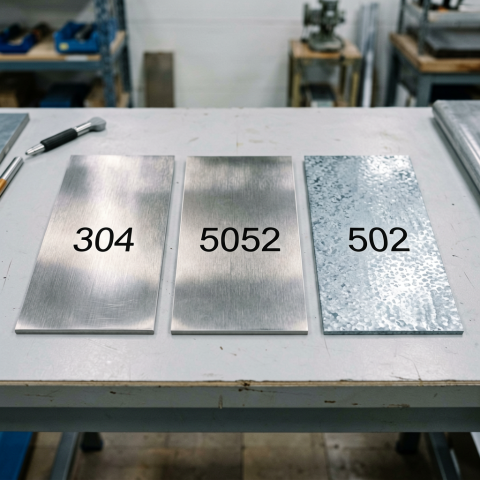
Sheet metal material samples labeled by grade — each grade has specific chemical and mechanical requirements defined by ASTM or EN standards.
What to Check on a Mill Test Report
When you receive an MTR from your manufacturer, verify these five items:
1. Material Grade and Specification
Confirm the grade matches what you ordered. For example, if you specified ASTM A240 304 stainless steel, the MTR should list ASTM A240 and grade 304. Mismatched grades are surprisingly common and can lead to corrosion or strength issues.
2. Chemical Composition
Check that the percentages of key elements fall within the required range. For 304 stainless, carbon should be 0.08% max, chromium 18-20%, and nickel 8-10.5%. Out-of-spec chemistry can affect weldability and corrosion resistance.
3. Mechanical Properties
Tensile strength, yield strength, and elongation should meet the standard's minimum requirements. For aluminum 5052-H32, tensile strength should be 210 MPa minimum and yield strength 130 MPa minimum.
4. Heat Number
The heat number is the unique identifier for the melt batch. It should be consistent across all sheets used in your prototype. Traceability back to the heat number is how manufacturers demonstrate material integrity.
5. Date and Supplier
The test date should be recent (within 1-2 years for most materials). The supplier name should match a known mill or distributor.
Material Certification Requirements by Industry
|
Industry |
Required Certifications |
Key Standards |
Notes |
|
Medical Devices |
Full MTR (EN 10204 3.1) |
ISO 13485, ASTM F138 (implant grade) |
Full traceability required for FDA submissions |
|
Aerospace |
Full MTR + AMS specs |
AMS QQ-A-250/8 (aluminum), AMS 5504 (steel) |
AMS specifications exceed ASTM requirements |
|
Automotive |
MTR or CoC depending on criticality |
IATF 16949, customer-specific standards |
Safety-critical parts need full MTR |
|
Food Processing |
MTR with surface finish data |
FDA CFR 21, 3-A Sanitary Standards |
Surface finish and corrosion resistance critical |
|
General Industrial |
CoC or MTR |
ISO 9001, applicable ASTM/EN standards |
MTR recommended for structural parts |
ISO 9001:2015 quality management standard covers general requirements, while TWI Global provides guidance on material selection for welded fabrications.
How Chinese Manufacturers Handle Material Certifications
When sourcing sheet metal prototypes from Chinese manufacturers, material certification practices vary significantly between suppliers. Here is what to expect:
· ISO 9001 certified suppliers: They maintain documented material receiving and inspection processes and can provide MTRs from their raw material suppliers.
· Large mills: Chinese steel mills like Baosteel, Tisco (stainless), and Chalco (aluminum) issue full MTRs with every coil or sheet, matching international standards.
· Smaller suppliers: They may rely on distributor-level CoCs. Always request the original mill MTR, not a re-issued certificate.
· Key red flag: A supplier who cannot or will not provide an MTR for the material used in your prototype is not suitable for regulated or quality-sensitive applications.
Xometry and Protolabs maintain material traceability across their supplier networks. RapidDirect and XHX Metal provide MTRs on request for all prototype materials.
Prototyping Services with Material Traceability
|
Provider |
MTR Available |
Standard Cert |
Material Range |
Notes |
|
XHX Metal |
Yes on request |
CoC standard |
Aluminum, steel, stainless |
Full traceability for prototype materials |
|
Xometry |
Yes |
CoC standard |
Extensive range |
Automated system, MTR by request |
|
Protolabs |
Limited |
CoC standard |
Aluminum, steel |
Fast turnaround, less flexible on certs |
|
RapidDirect |
Yes |
CoC standard |
Aluminum, steel, stainless |
China-based, MTR available |
|
SendCutSend |
Limited |
CoC standard |
Steel, aluminum |
USA-based, fast but limited certs |
|
KDM Fabrication |
Yes on request |
CoC standard |
Aluminum, steel, stainless |
China-based, precision focus |
XHX Metal: Material Certification Practices
At XHX Metal, material verification is the first step in every prototype order. Our process includes:
· Incoming material inspection: Each sheet or coil is verified against its MTR before entering production.
· Grade confirmation: Material grade is marked and tracked throughout the fabrication process.
· MTR on request: We provide the original mill test report for any material used in your prototype.
· ISO 9001:2015 certified: Our quality management system requires documented material traceability.
· Full material range: We stock 304/316L stainless, 5052/6061 aluminum, SPCC/SGCC steel, and more.
Contact XHX Metal to request material certifications with your next prototype order.
Frequently Asked Questions
Q: What is the difference between an MTR and a CoC?
A: An MTR (Mill Test Report) includes actual test data from the mill showing chemical composition and mechanical properties. A CoC (Certificate of Compliance or Conformance) simply states the material meets requirements without providing test data.
Q: Do I need an MTR for prototypes?
A: For non-critical fit/form prototypes, a CoC is usually sufficient. For functional prototypes, especially those used in medical, aerospace, or automotive development, a full MTR is recommended.
Q: Can Chinese manufacturers provide MTRs?
A: Yes, ISO 9001 certified Chinese manufacturers can provide MTRs from their raw material suppliers. Always request the original mill MTR, not a re-issued certificate.
Q: What should I check on an aluminum MTR?
A: Confirm the grade (5052, 6061, etc.), temper (H32, T6, O), thickness tolerance, tensile and yield strength, and elongation percentage.
Q: How do I verify a material certificate is authentic?
A: Check that the heat number is unique and not duplicated across different materials. Request the original document (not a photocopy). Cross-reference the mill name with known producers.
Q: What if my manufacturer cannot provide an MTR?
A: For critical applications, this is a red flag. Consider using a manufacturer with documented material traceability processes, or order material from a known distributor and supply it to the fabricator.
Conclusion
Raw material certifications are a critical but often overlooked aspect of sheet metal prototyping. For R&D teams developing products that will enter production, verifying material quality through proper documentation is not optional.
Always request an MTR for functional prototypes, confirm the grade and specification match your requirements, and work with manufacturers who maintain material traceability as part of their quality system.
Contact XHX Metal for your next sheet metal prototype project.