
EMC and EMI Shielding Design for Medical Power Supply Enclosures
EMC and EMI Shielding Design for Medical Power Supply Enclosures
Medical power supplies must meet stringent electromagnetic compatibility (EMC) requirements to ensure they do not interfere with other medical equipment and are not susceptible to external electromagnetic interference (EMI). The enclosure plays a critical role in achieving EMC compliance.
For R&D teams developing medical power supplies, understanding how sheet metal enclosure design affects EMI shielding performance is essential. This guide covers the key design principles, materials, and compliance standards for medical-grade shielded enclosures.
Why EMC Matters for Medical Power Supplies
Medical power supplies operate in environments with sensitive equipment: patient monitors, ventilators, MRI machines, and surgical robots. Uncontrolled EMI can cause:
· False readings on patient monitoring equipment
· Communication errors between connected devices
· Malfunction of life-support equipment in critical situations
· Non-compliance with regulatory standards, delaying market entry
Regulatory bodies worldwide enforce EMC standards for medical electrical equipment. In the US, the FDA requires compliance with IEC 60601-1-2. In the EU, the Medical Device Regulation (MDR) mandates EMC testing as part of CE marking.
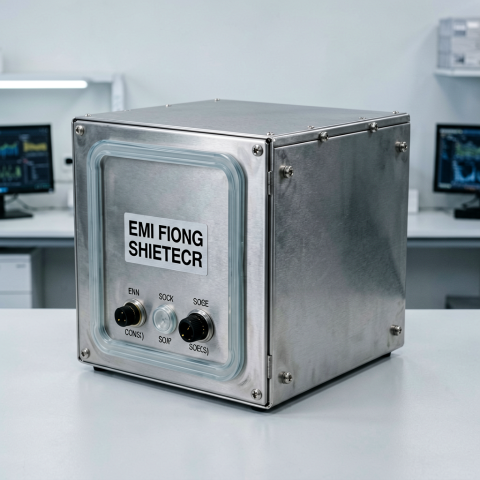
Medical power supply sheet metal enclosure with conductive gaskets and EMI shielding features.
Sheet Metal Shielding Principles
Sheet metal enclosures provide natural EMI shielding because metals are conductive and reflect or absorb electromagnetic waves. The effectiveness of a shield depends on three factors:
Reflection Loss
When an electromagnetic wave encounters a conductive surface, most of the energy is reflected. This is the primary shielding mechanism for sheet metal enclosures. Materials with higher conductivity (copper, aluminum) provide better reflection.
Absorption Loss
Some energy is absorbed as it passes through the metal. Thicker materials and materials with higher magnetic permeability (steel) provide better absorption. At typical medical power supply frequencies (100 kHz to 1 GHz), 1-2 mm sheet metal provides adequate absorption.
Multiple Reflections
In thin shields, energy can bounce between the inner and outer surfaces of the metal, reducing overall effectiveness. This is rarely an issue with standard sheet metal gauges used in medical enclosures.
Key Enclosure Design Features for EMI Shielding
1. Continuous Conductive Seams
The most common cause of shielding failure is gaps in the enclosure seams. Every seam, joint, and interface is a potential leakage point. Best practices include:
· Welded corners instead of bolted or riveted joints
· Continuous seam welding (not stitch welding) for critical seams
· Conductive gaskets at removable panel interfaces
· EMI finger stock at door and access panel edges
2. Aperture Control
Every opening in the enclosure acts as a slot antenna that can radiate or receive EMI. Control apertures by:
· Keeping ventilation holes round rather than square (round has smaller effective aperture)
· Using honeycomb ventilation panels for large cooling openings
· Limiting slot length to less than 1/20 of the wavelength at the highest frequency of concern
· Applying conductive mesh over display windows
3. Grounding and Bonding
A shielded enclosure is only as effective as its ground connection. Design considerations include:
· Low-impedance ground connection between the enclosure and the power supply ground
· Bonding all enclosure panels together with conductive paths
· Using zinc-plated or stainless steel hardware for corrosion-resistant grounding
· Avoiding painted or anodized surfaces at contact points (they are insulators)
4. Cable Entry and Filtering
Cables entering and exiting the enclosure are major EMI paths. Mitigation strategies:
· Use shielded cables with 360-degree termination at the enclosure entry point
· Install EMI feedthrough filters at power input connections
· Position cable entries away from noise sources inside the enclosure
· Use ferrite beads on internal cables to suppress common-mode noise
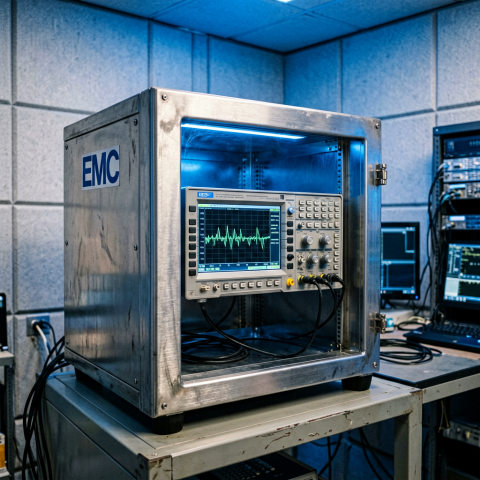
EMC testing in a shielded laboratory environment. Enclosure design is verified through formal radiated and conducted emissions testing.
Material Selection for EMI Shielding
|
Material |
Conductivity |
Shielding Effectiveness |
Cost |
Best For |
|
Galvanized Steel |
Moderate |
Good (magnetic absorption) |
$ |
Cost-effective medical enclosures |
|
Cold-Rolled Steel |
Moderate |
Good |
$ |
Indoor medical equipment |
|
Aluminum 5052 |
High |
Good (reflection dominant) |
$$ |
Lightweight portable devices |
|
Stainless Steel 304 |
Moderate |
Good (corrosion resistant) |
$$$ |
Sterile environment equipment |
|
Copper (lining) |
Excellent |
Excellent |
$$$ |
High-sensitivity applications |
EMC Standards for Medical Power Supplies
|
Standard |
Region |
Scope |
Key Requirements |
|
IEC 60601-1-2 |
International |
EMC for medical electrical equipment |
Emissions and immunity limits for medical devices |
|
CISPR 11 / EN 55011 |
International / EU |
Industrial, scientific, medical equipment |
Radiated and conducted emissions limits Class A/B |
|
FCC Part 15 |
USA |
Radio frequency devices |
Emissions limits for unintentional radiators |
|
IEC 61000-4-2 |
International |
Electrostatic discharge immunity |
+/-8 kV contact, +/-15 kV air discharge |
|
IEC 61000-4-3 |
International |
Radiated RF immunity |
3 V/m to 10 V/m field strength |
|
IEC 61000-4-4 |
International |
Electrical fast transient immunity |
+/-2 kV coupling to power lines |
IEC 60601-1-2 EMC standard for medical electrical equipment is the primary reference. Additional guidance is available from the FDA's EMC guidance for medical devices.
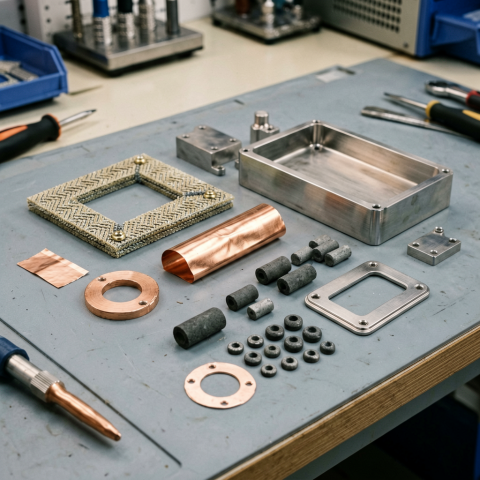
EMI shielding components: conductive gaskets, copper tape, and ferrite beads used in medical enclosure design.
Design Process for EMI-Shielded Medical Enclosures
1. Define Frequency Range and Shielding Requirement
Identify the frequency range of concern based on the power supply design and target market. Typical medical power supplies require shielding from 150 kHz to 1 GHz, with 30-60 dB of attenuation depending on the application.
2. Select Enclosure Material and Thickness
Choose based on conductivity, cost, and structural requirements. For most medical power supplies, 1.2-1.5 mm galvanized steel or 2 mm aluminum provides adequate shielding.
3. Design Seams and Joints
Plan for continuous conductive paths at all enclosure joints. Specify welded seams for permanent joints and conductive gaskets for removable panels.
4. Plan Apertures and Penetrations
Design ventilation, cable entry, and display openings with shielding in mind. Use honeycomb vents, shielded cable glands, and conductive gaskets at every penetration.
5. Design Grounding System
Plan the ground path from the enclosure to the power supply ground. Ensure all panels have a low-impedance connection to ground.
6. Prototype and Test
Fabricate a prototype enclosure and perform pre-compliance EMC testing. Identify and fix shielding issues before formal certification testing.
Prototyping Partners for Shielded Medical Enclosures
|
Provider |
Medical Experience |
Shielding Capability |
Certifications |
|
XHX Metal |
Yes - medical enclosures |
Welded seams, gasket grooves, conductive coating |
ISO 9001, CE |
|
Protolabs |
Limited |
Standard sheet metal |
ISO 9001 |
|
RapidDirect |
Growing |
Gasket installation available |
ISO 9001 |
|
Xometry |
Yes - network suppliers |
Varies by supplier |
Varies |
|
KDM Fabrication |
Yes - precision enclosures |
Welded, gasketed |
ISO 9001 |
RapidDirect, Xometry, and KDM Fabrication are alternative options for shielded medical enclosures.
XHX Metal: Medical Enclosure Manufacturing Expertise
XHX Metal has produced sheet metal enclosures for medical devices and power supplies. Our capabilities relevant to EMI-shielded enclosures include:
· Precision laser cutting with +-0.01 mm accuracy for tight-tolerance gasket grooves and mounting holes
· TIG and laser welding for continuous seam joints
· CNC bending for consistent enclosure geometry
· In-house powder coating with masking for conductive surfaces
· Experience with IEC 60601-1-2 enclosure requirements
· Prototype orders from 1 piece for design validation
Contact XHX Metal for your medical enclosure project or explore our enclosure manufacturing capabilities.
Frequently Asked Questions
Q: What shielding effectiveness can I expect from a sheet metal enclosure?
A: With proper design (welded seams, conductive gaskets, controlled apertures), 40-60 dB of shielding from 100 kHz to 1 GHz is achievable with standard sheet metal.
Q: Is galvanized steel or aluminum better for EMI shielding?
A: Galvanized steel provides better absorption at low frequencies due to its magnetic properties. Aluminum provides better reflection at high frequencies. Both work well for medical power supplies.
Q: Do I need conductive gaskets, or will a bare metal overlap work?
A: Bare metal overlap is unreliable due to oxidation and surface irregularities. Conductive gaskets (silicone with silver or nickel filler) provide consistent, repeatable conductivity at seam interfaces.
Q: How do I ensure my enclosure passes IEC 60601-1-2 testing?
A: Start with a well-designed shield, use pre-compliance testing during development, and work with a manufacturer experienced in medical enclosure fabrication.
Q: What thickness of sheet metal is needed for EMI shielding?
A: For medical power supplies operating below 1 GHz, 1.0-1.5 mm (18-16 gauge) steel or 1.5-2.0 mm aluminum is typically sufficient.
Q: Can you add shielding features to an existing enclosure design?
A: Yes. Conductive gaskets can be added to existing seam interfaces, and aperture covers or honeycomb vents can be retrofitted. However, it is more cost-effective to design for shielding from the start.
Conclusion
EMI shielding design is a critical aspect of medical power supply enclosure development. Proper enclosure design, material selection, and attention to seams, apertures, and grounding can significantly reduce EMC compliance risk and speed time to market.
Partner with a sheet metal manufacturer who understands medical enclosure requirements and can fabricate prototypes with the precision and quality needed for regulatory testing.
Contact XHX Metal to discuss your medical power supply enclosure project.