
Battery Enclosure Prototyping for R&D Teams: Custom Sheet Metal Solutions
Battery Enclosure Prototyping for R&D Teams: Custom Sheet Metal Solutions
Battery enclosures are one of the most critical structural components in modern product development. From electric vehicles and energy storage systems to medical devices and robotics, the housing that protects the battery pack directly impacts safety, thermal performance, and product reliability.
For R&D teams developing battery-powered products, prototyping the enclosure is a key milestone. This guide covers why sheet metal fabrication is the preferred method for battery enclosure prototyping, the design considerations you need to get right, and how to choose the right manufacturing partner.
Why Sheet Metal for Battery Enclosure Prototypes?
Sheet metal fabrication offers unique advantages for battery enclosure prototyping that other processes cannot match:
· Material parity: Sheet metal prototypes use the same aluminum or steel as production parts, giving you valid thermal and mechanical test data.
· Speed: Laser-cut and formed enclosures ship in 5-12 business days, enabling rapid design iteration.
· No tooling: Unlike die casting or injection molding, sheet metal requires zero tooling investment for prototypes.
· EMI shielding: Metal enclosures provide natural electromagnetic interference protection for sensitive battery management systems.
· Scalability: The same design flows directly from prototype to production without re-engineering.
SendCutSend and PCBWay offer fast-turnaround sheet metal prototyping for battery enclosure components.
Key Design Considerations for Battery Enclosures
Battery enclosures have unique requirements that go beyond standard sheet metal fabrication. Here is what R&D teams need to address:
Thermal Management
Batteries generate significant heat during charging and discharging. Your enclosure design should incorporate ventilation slots, heat sink mounting provisions, or liquid cooling channel interfaces. Aluminum 5052 or 6061 is the preferred material for its thermal conductivity.
Design tip: Louvered vents or perforated panels provide airflow while maintaining structural integrity and EMI shielding. For high-power applications, consider adding mounting bosses for heat sinks or Peltier coolers.
IP Sealing and Environmental Protection
Battery enclosures often require IP54 (indoor) to IP67 (outdoor/immersible) ingress protection. This requires precision-cut gasket grooves, compatible EPDM or silicone gaskets, and compression sealing. Sheet metal fabrication can achieve these with consistent quality.
Electrical Safety and Insulation
Battery enclosures must prevent electrical contact between the battery pack and the metal housing. Common approaches include interior insulating liners (polycarbonate or FR4 sheets), powder-coated interior surfaces for electrical isolation, and clearly marked grounding points.
Cable Entry and Connector Mounting
Battery packs require high-current cable entries, signal connectors, and sometimes cooling ports. Design cable gland plates with multiple entry sizes, and use precision punch or laser-cut holes for connector mounting. Threaded inserts (self-clinching nuts) provide reliable mounting points for connectors.
Structural Integrity and Crash Safety
For EV and automotive battery enclosures, structural rigidity is critical. Consider adding formed ribs, welded stiffeners, or corrugated panels to increase strength without adding weight. Finite element analysis (FEA) during the design phase helps optimize the structure.
For detailed design standards on battery enclosure safety, refer to
Engineers Edge structural design guides and TWI Global welding best practices.
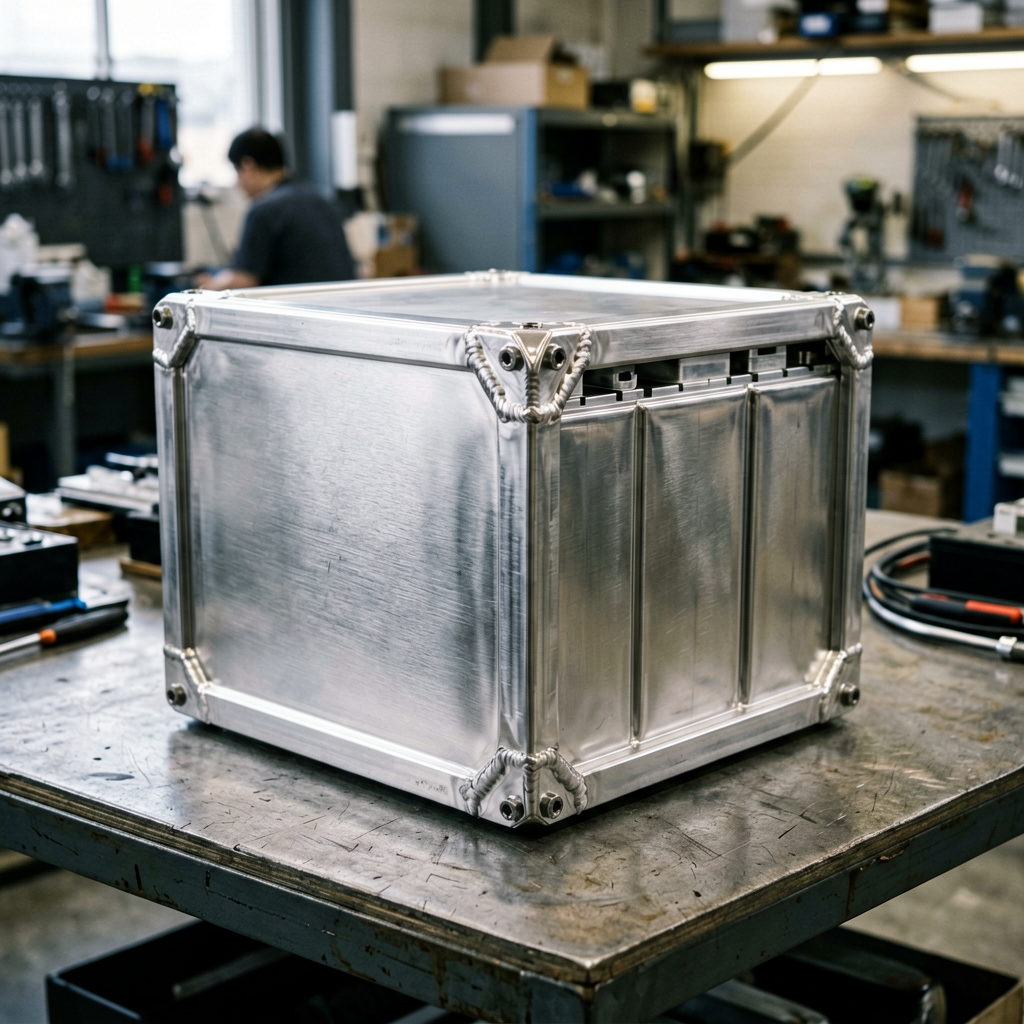
Custom sheet metal battery enclosure prototype with precision welding, cable entry points, and powder-coated finish.
Material Selection for Battery Enclosures
|
Material |
Weight |
Thermal Conductivity |
Corrosion Resistance |
Cost |
Best For |
|
Aluminum 5052-H32 |
Light |
Excellent |
Good |
$$ |
EV/robotics battery housings |
|
Aluminum 6061-T6 |
Light |
Excellent |
Good |
$$ |
Structural battery frames |
|
Galvanized Steel SGCC |
Heavy |
Moderate |
Good |
$ |
Stationary energy storage |
|
Stainless Steel 304 |
Heavy |
Moderate |
Excellent |
$$$ |
Marine/medical batteries |
|
Cold-Rolled Steel SPCC |
Heavy |
Moderate |
Poor (needs coating) |
$ |
Indoor prototypes |
MatWeb material property database provides detailed thermal and mechanical data for all grades.
The Battery Enclosure Prototyping Process
Here is how a typical battery enclosure prototype moves from CAD to finished part:
1. Design and DFM Review
Submit your 3D model (STEP/IGES). The manufacturer reviews bend radii, hole placement relative to bends, weld joint design, and gasket groove geometry specific to battery enclosure requirements.
2. Precision Laser Cutting
Fiber laser cutting produces flat patterns with +-0.01 mm accuracy. Features like ventilation slots, cable entry holes, and mounting points are cut in this step.
3. CNC Bending and Forming
The flat pattern is formed into 3D shape using precision press brakes. For battery enclosures, consistent bend angles are critical for gasket compression and IP sealing.
4. Welding and Assembly
TIG welding for aluminum enclosures (to prevent porosity) or MIG for steel. All welds inspected for structural integrity and seal quality. Seam welding is used for IP-rated enclosures.
5. Surface Finishing
Powder coating for corrosion protection and electrical insulation. Anodizing for aluminum enclosures. Interior insulating liners installed if required.
6. Testing and Inspection
CMM dimensional verification, IP sealing test (if rated), fit check with battery pack mock-up, and surface finish quality check.
Battery Enclosure Prototyping Services Comparison
|
Provider |
Turnaround |
MOQ |
Materials |
Battery Experience |
|
XHX Metal |
5-12 days |
1 pc |
Aluminum, steel, stainless |
Yes - EV, solar, robotics |
|
RapidDirect |
5-12 days |
1 pc |
Aluminum, steel, stainless |
Yes - general battery enclosures |
|
Xometry |
5-12 days |
1 pc |
Wide range |
Yes - network of suppliers |
|
Protolabs |
3-10 days |
1 pc |
Aluminum, steel |
Limited |
|
PCBWay |
5-10 days |
1 pc |
Aluminum, steel |
Growing |
|
KDM Fabrication |
7-15 days |
1 pc |
Aluminum, steel, stainless |
Yes - precision enclosures |
RapidDirect, Xometry, and KDM Fabrication are strong alternatives. XHX Metal offers the most direct battery enclosure experience.
XHX Metal: Battery Enclosure Prototyping Expertise
Guangdong Xinghaoxin Technology Co., Ltd. (XHX Metal) has produced battery enclosures for EV, solar energy storage, and robotics applications. Our experience includes IP65-rated outdoor battery housings and lightweight aluminum enclosures for mobile applications.
Our battery enclosure prototyping capabilities include:
· Two 6kW fiber laser cutting machines with +-0.01 mm precision for accurate gasket grooves and mounting holes
· Precision CNC bending for consistent enclosure geometry and reliable IP sealing
· TIG welding for aluminum battery housings with leak-tight seams
· Powder coating and anodizing for corrosion protection and electrical insulation
· CMM inspection and IP sealing verification on every prototype
· Prototype orders from 1 piece, production from 10 pieces
Battery enclosure pricing examples: EV battery housings (custom) from $30-80/piece at prototype quantities, and solar energy storage cabinets from $450-550/piece.
Contact XHX Metal for a battery enclosure prototype quote or view our sheet metal enclosure capabilities.
Frequently Asked Questions
Q: How fast can I get a battery enclosure prototype?
A: Typically 5-12 business days for a laser-cut and formed enclosure. Add 3-7 days for powder coating or anodizing.
Q: What material is best for a battery enclosure prototype?
A: Aluminum 5052-H32 is the most common choice due to its light weight, good thermal conductivity, and ease of forming. For stationary storage, galvanized steel is more cost-effective.
Q: Can you make IP67-rated battery enclosures?
A: Yes. IP67 requires precision-cut gasket grooves, compatible silicone gaskets, and compression sealing. XHX Metal tests sealed enclosures for IP rating compliance.
Q: What is the MOQ for battery enclosure prototypes?
A: 1 piece for prototypes. Production MOQ from 10 pieces.
Q: What file format do you need?
A: STEP (.stp) or IGES (.igs) for 3D models. A PDF drawing with critical dimensions, tolerances, and material specs is also helpful.
Q: Do you include thermal management features?
A: Yes. We can integrate ventilation louvres, heat sink mounting bosses, and liquid cooling port interfaces into the enclosure design.
Conclusion
Battery enclosure prototyping is a critical step in developing safe, reliable battery-powered products. Sheet metal fabrication offers R&D teams the fastest path from CAD to functional prototype, with material parity to production and no tooling investment required.
When choosing a prototyping partner, look for experience with battery enclosures specifically, in-house multi-process capabilities, and a willingness to start with single-piece prototypes.
Contact XHX Metal to start your battery enclosure prototype.